Redefining Early Detection in Neurodegenerative Care
For years, confirming Alzheimer’s pathology required navigating two extremes: invasive lumbar punctures or scarce, cost-prohibitive PET imaging. Consequently, clinical diagnosis frequently arrived too late—well after significant neuronal loss had taken place.
The emergence of plasma biomarkers (such as p-Tau217, p-Tau181, and the Aβ42/Aβ40 ratio) represents a paradigm shift. How does blood-based screening compare to conventional diagnostic standards in real-world clinical practice?
Comparative Evaluation Matrix
| Parameter | Blood-based Biomarker Test | Cerebrospinal Fluid (CSF) Analysis | Amyloid / Tau PET Imaging |
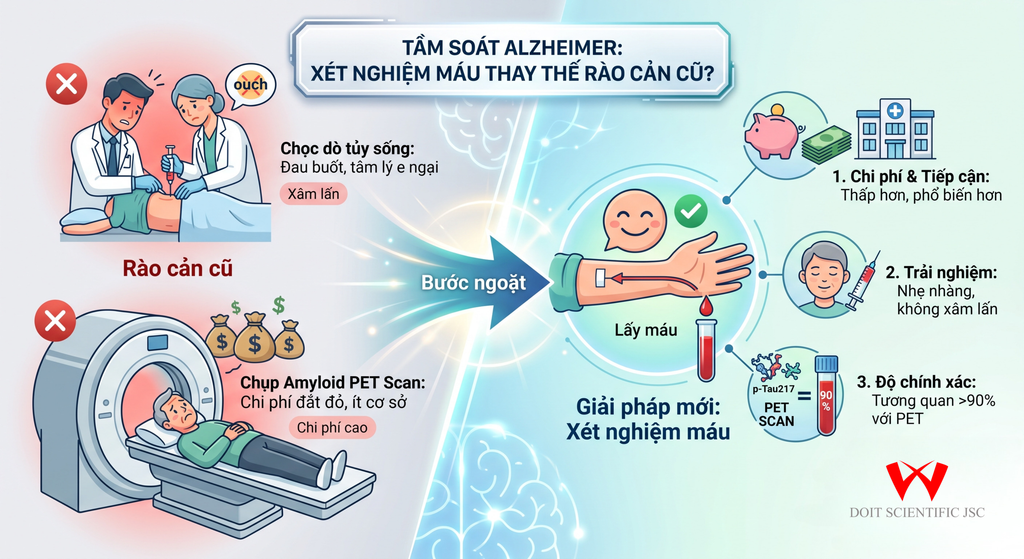
| Sampling & Workflow | Routine peripheral venipuncture (3–5 mL). Fast outpatient procedure. | Lumbar puncture required. Must be performed by trained specialists in sterile settings. | IV tracer injection followed by 30–60 minutes of motionless scanning. |
| Patient Experience | Optimal. Minimal discomfort, no recovery downtime, negligible procedure-related anxiety. | Low. Risk of post-dural puncture headache, backache, and patient apprehension. | Moderate. Non-invasive but involves low-dose radiation exposure and immobility. |
| Cost & Scalability | Most Cost-Effective. Roughly 10–20% of PET costs; easily integrated into standard automated lab pipelines. | Moderate. Involves procedural overhead, monitoring, and specialized CSF handling. | High. High equipment barrier; restricted to tertiary medical centers with radiopharmacy facilities. |
| Diagnostic Correlation | Exceptional (Novel assays show >90–95% concordance with amyloid PET/CSF profiles). | Established molecular gold standard (>95% sensitivity & specificity). | Definitive spatial gold standard for plaque visualization. |
| Primary Clinical Utility | Frontline screening, broad-cohort monitoring, pre-symptomatic risk stratification. | Differential confirmation in complex neurodegenerative profiles. | Definitive plaque quantification and candidate selection for targeted therapies. |
Key Takeaway for Healthcare Providers
Blood biomarkers serve as the essential frontline triage solution:
- Democratizing access: Eliminating financial and procedural barriers to facilitate large-scale early detection.
- Streamlining clinical pathways: Reserving high-cost PET and lumbar punctures for patients who truly require tertiary verification.
- Timely therapeutic window: Identifying neurodegenerative hallmarks years before overt cognitive decline begins.